



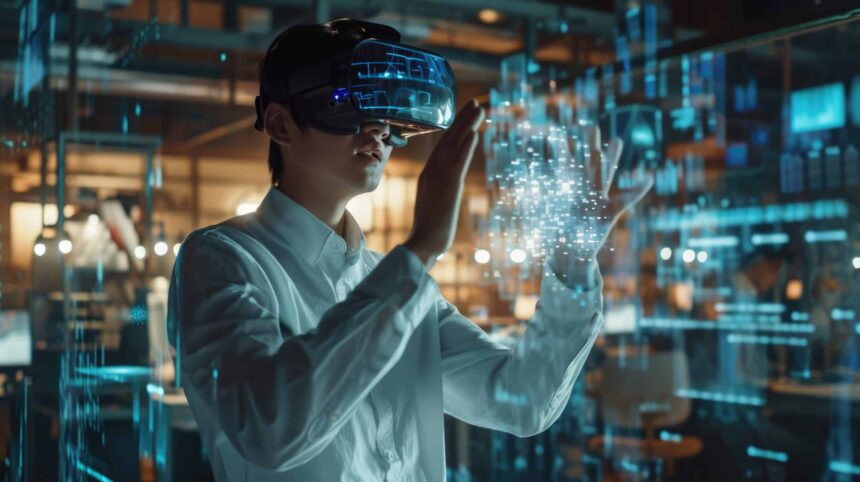
AR and VR are uniting with edge computing in the ever-evolving digital environment to revolutionize the world of business. These AR/VR edge solutions will minimise latency, fast-track processing, and create immersive experiences. Businesses are adopting the use of these technologies to foster innovation and facilitate growth in smart manufacturing as well as other sectors of healthcare and education. This article discusses ten motivating AR/VR edge solutions that are transforming how we interact intelligently and data-driven.
- Live Virtual Teamwork.
Real-time collaboration is the first significant advantage of AR/VR edge integration. AR/VR headsets with edge servers can support virtual workspaces shared by teams that work across various sites. This minimizes the time taken to transfer data and improves the quality of communications. The ability to co-create 3D models like engineers, architects, and designers minimizes in the same room and noticeably helps them to make decisions and be productive faster.
- Simulation-Based Education and Training.
AR/VR edge solutions have enabled education and training programs to be more interactive. With edge computing, institutions can stream quality virtual simulation programs without connecting to remote cloud servers. With real-time input and fluid rendering, virtual reality allows industrial workers to learn safely in virtual surroundings, pilots to practise flights, and medical students to practice procedures.
- Intelligent Factory Productivity.
At the edge, manufacturing plants are taking advantage of AR/VR to streamline their operations. With the integration of sensors and AR-based instructions, employees can oversee machines, observe errors, and obtain real-time data overlays. DoverlaysAtata can be processed by edge servers in real-time, overlays. Real-time decisions can be made more quickly. This integration saves downtime in real time, enhances quality control, and increases the overall productivity of the plant.
- Next-Gen Retail Experiences
Retailers are adopting AR/VR edge solutions to provide customers with a personalized and dynamic customer experience. Customers can see goods from the comfort of their houses, virtually try clothes, or even live in virtual showrooms, with virtually no latency. Systems that are enabled with edges render faster, producing realistic experiences, which boost brand loyalty and sales.
- Medical and Health Care Research and Development.
AR/VR and edge computing in the healthcare industry enable visualization of images and data in a precise and real-time manner. These overlays enable surgeons to see information on the device during the operation, which the edge servers are processing in real time. This ensures accuracy, enhances patient safety, and enables remote medical consultations with a high-quality image.
- Improved Playing and Entertainment.
AR/VR experiences based on the edge have enabled gaming platforms to go to a higher level. Players do not have to wait anymore to enjoy lifelike graphics and interactive environments. Edge computing minimises lag and makes all movement, sound, and visual effects feel natural. This technology is employed in concerts, sports simulations, and immersive storytelling in the entertainment industry.
- Intelligent Urban Planning
AR and VR are useful at the edges of urban development projects. Planners can see 3D images of complete cities, experiment with infrastructure designs, and model environmental impacts in real-time eal time. The ability to process data on edge servers enables efficient analysis of complex datasets by urban designers ers real time. Designers, causing smarter, sustainable city planning.
- Simulations in Military and Defense Designers, Defense.
AR/VR edge tools are being used by defense organizations in realistic simulation and mission training. Such systems enable soldiers to train in simulated virtual battlefields and get immediate feedback. Edge computing upholds that bulky amounts of tactical information are computed safely on-site, enhancing decision-making for defense organisations and readiness without endangering lives.
- Tourism and the Preservation of Culture.
Immersive AR/VR experiences are being leveraged by the tourism industry to rekindle historical sites and encourage virtual tourism. Visitors may be able to learn about ancient ruins, museums, or heritage sites using AR/VR edge solutions to experience them as hyper-realistic simulations. The edge network embraces easy-to-see images and interactive storytelling, which facilitates the preservation of culture for international audiences.
- Field Service and Maintenance.
Energy, telecommunications, and logistics technicians use AR overlays and VR simulations to troubleshoot and repair. With edge computing, you can access 3D schematics and real-time sensor information in seconds. Employees wearing AR glasses will be able to see the instructions and fix the points of the task and reducing downtime and expenses.
(FAQs)
Q1: How are AR/VR edge solutions different from traditional AR/VR systems?
Conventional AR/VR devices use remote cloud servers, which lead to latency problems. AR/VR edge solutions with local servers process data closer to the user, leading to faster execution and real-time interaction.
Q2: What industries does the AR/VR edge technology serve best?
The greatest beneficiaries of speed, security, and immersion are industries that need them, such as healthcare, manufacturing, retail, defense, education, and gaming.
Q3: What are AR/VR edge solutions, and how do they facilitate digital transformation?
By processing massive amounts of data in real time at the network edge, they are faster, more engaging, and more productive.
Q4: Do AR/VR edge systems prove to be costly?
They may be expensive at first, but the long-term advantages of a shorter latency, greater efficiency, and better customer interactions make them worth it.
Q5: How does the AR/VR edge integration look in the future?
As the industry gains more power with 5G and AI, these solutions will be even more robust and will allow smarter, more immersive environments in every sector.
Conclusion
The creation of AR/VR edge solutions is re-engineering how humans interact with technology. These technologies can make companies smarter and faster, be it via real-time collaboration or the force of technological progress in the world of gaming and medicine. The integration of the immersive features of AR/VR and the speed of edge computing will help companies build robust digital ecosystems that aid innovation, enhance productivity, and foster long-term success. The future of all those embracing this edge reality today is theirs.