



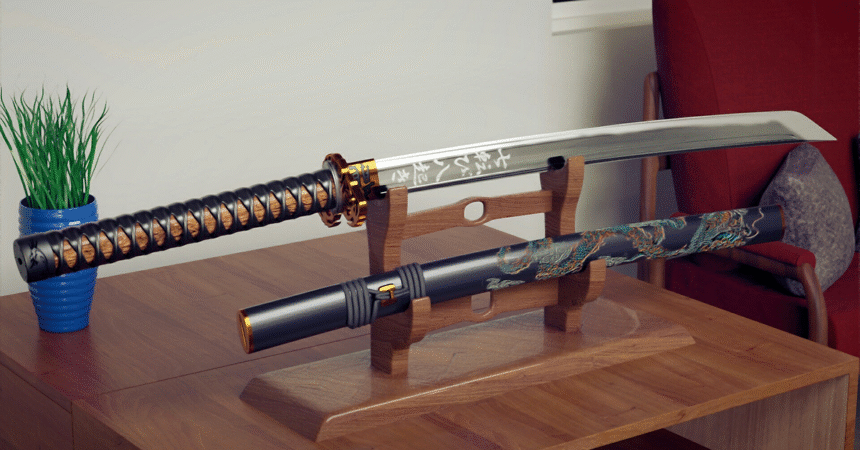
The curved katana is not just a steel weapon but a heritage, craftsmanship, and culture that has withstood the ages. It was made in the Japanese way and filled with the genius of the warrior and the subtlety of the smith. Every curve, every edge, and every polish is a measure of power, beauty, and civilization. There then follow ten beautiful observations on the art of this immortal blade.
- A Symbol of Samurai Spirit
The samurai spirit has been linked with the curved katana. It represented discipline, loyalty, and honor. It was not just a weapon but rather an extension of the soul of warriors. The curvy line depicted the unity they wanted in life and in war.
- Forging Technique Mastery.
Creating a katana required unprecedented craft and incredible patience. To eliminate impurity and to create strength, blacksmiths folded the steel seven times. What came out of this process was the unique blade structure that was valued due to its durability and cutting capacity. It was a fast and accurate curve.
- Superlative balance of art and purpose.
The craft of the bent katana was going to be a beautifully ornamental instrument as well as a practical one. Its forging edge was narrow, and its line was flowing, to make it a sight to be feared. But, like beauty, it was also a perfectly maintained sword, which could be used to make the fatal hits in a fight.
- The Defiance of the Blade.
Samurai believed that the curved katana was not entirely composed of steel. It was a spiritual transmission, in most cases inherent. These blades were sacrosanct between families. Most rituals exaggerated the katana, which reinforced the warrior-tradition association.
- The Plasticity of War.
This curve was not created to be pretty. The arc made it easier and faster to draw the sword, and this made it possible to strike the sword once. This design gave the katana an advantage in close combat, where precise timing and accuracy were a life-or-death issue.
- Polishing as a Form of Art
Polishing was not an easy process; it was an art. Each katana took days or weeks before experts polished it to bring out the beauty of the sword. The operation exposed the detailed texture of the steel and provided the blade with the perfect finish. This craft enabled each curved katana to be individual.
- Japanese Culture Emblem all over the world.
The katana has expanded over centuries outside of battlefields to become a cultural icon. The curved katana is now being commemorated in museums, martial arts schools, and by collectors. It is not only Japanese tradition but also the admiration of the world towards the accuracy and beauty of craftsmanship.
- Influence on martial arts.
The martial arts Iaido and Kendo were influenced by the sword. Artisans learned the art of quick drawing, the art of movement, and controlled blows. These rituals are rooted in large part in the curved katana that taught earlier generations respect, patience, and control of the body and spirit.
- The Peace of Blade and Scabbard.
The other lesson is the balance between the blade and the scabbard, the saya. The scabbards were designed to match the katana. This union symbolized harmony and wholeness, and this once again demonstrates that the curved katana was not merely a weapon but a work of art.
- Tradition of Classic Art.
Katana is a legacy that motivates artists, craftsmen, and martial artists. Nowadays, the curved katana evokes the eternal loveliness of Japanese culture. It is not only steel that is art, but the values of dedication, honor, and perfection it embodies.
(FAQs)
Q1: Why is the katana curved?
It can be used on the battlefield, and the curve can be drawn faster with ease of cutting.
Q2: Did all samurai have to be armed with a katana?
Yes, these samurai were expected to have swords, sometimes two, the curved katana being the primary one.
Q3: Is the katana really even extant nowadays?
It is no longer used as an arm of war, although it continues to be used as an aid in martial arts and in museums and art collections.
Question 4: Katana: How many hours to make a katana?
Depending on the fineness and the finesse, it will take them days or even weeks to develop.
Conclusion
The curved katana is one of the masterpieces of culture and art. Not only is it a design decision, but also a practical feature that characterized centuries of fighting and convention. Every blade is a tale of discipline, commitment, and artistry. The study of the katana is a way to experience the balance of the beauty, power, and spirituality contained within it. The craft of the curved katana is eternal, and it helps us to keep in memory the high principles that ruled the warrior who wielded it.