


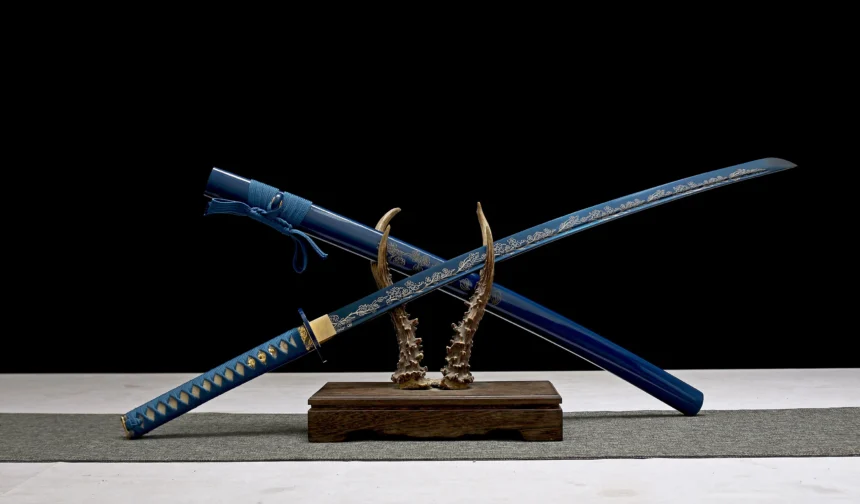
Japanese sword making is an art of accuracy, tradition, and beauty. The most interesting of its features is the Hamon (katana blade pattern), a truly beautiful line of visual unity that is traced at the perimeter of the blade, and which symbolizes the soul of the craftsman. This design is not solely aesthetic, as it represents the sophisticated procedure of differentiation hardening resulting in the cutting edge and tough backbone of a katana. Here are ten of the most beautiful Hamon designs that have captivated collectors, martial artists, and art lovers throughout the world.
- Suguha (Straight Line Hamon)
The easiest and most beautiful pattern is the Suguha pattern. It runs parallel to the cutting edge, a symbol of purity, calmness, and precision. The swordsmiths prefer this design, as it has a clean appearance and a historical relation to the ancient Japanese blades. Its straight line of heat control gives it an even temper, and it is usually appreciated by traditionalists who hold that discipline is important in craftsmanship.
- Notare (Wavy Hamon)
The Notare is designed with undulating lines across the blade. It brings about movement and grace, which is usually similar to ocean waves. Plenty of fans of swords find Notare Hamon a peaceful and strong reflection of harmony between nature and steel. It is beautifully caught in its gentle undulations, which bring out the curvature and polish on the blade.
- Gunome (Rounded Wave Hamon)
The rounded humps in gnome patterns resemble, in form, a series of small swelling hills. This pattern is an equilibrium of beauty and power that shows how well a swordsmith can control the temperature in his hardening. The alternating shapes create a rhythmic effect on the blade, rendering every katana distinctive. Gunome Hamon appeals to collectors because of its vibrant nature and extensive historical underpinning in samurai culture.
- Choji (Clove-Shaped Hamon)
Patterns of choji hamon have the shape of clove buds or flower petals. These artistic forms were popularly used in the Kamakura period in Japan. The Choji pattern is a symbol of life and vitality, and every bud represents the creativity of the smith. The Choji Hamon is a popular sword art among collectors because, when polished, it reflects light in enchanting manners.
- Midare (Irregular Hamon)
The Midare pattern is not symmetrical like the uniform forms; it has irregular and uneven curves and waves. This indeterminacy gives the sword a personality and, therefore, freedom and uniqueness. It takes days for this steel to melt sufficiently pure in a clay furnace known as a tatara. In order to remove impurities and increase the metal’s strength and flexibility, swordsmiths fold the metal numerous times.
- Hitatsura (Full Temper Hamon)
“Hitatsura” means “full temper,” and this pattern is stretched throughout the blade and not on the edge. It is a cloud-like, scattered mark, which also creates the mysticism around the sword. This design was believed to be a source of spiritual energy by the Samurai. The Hitatsura Hamon is a blend of artistic expression and technical excellence, typically of high-grade custom blades.
- Toranba (Wave Hamon Billowing)
Toranba translates to “tiger stripe,” and its rippled, billowing wave formation really is as violent as the name suggests. It conveys the feeling of bellowing energy that is frozen in steel. Modern smiths prefer this design because they desire their work to be distinctive. The Toranba Hamon incorporates the power and courage of the samurai spirit and is, therefore, fierce and powerful.
- O-Midare (Big Irregular Hamon).
The Midare pattern is a larger and more dramatic pattern called O-Midare. It is characterized by sweeping irregular lines that are bold and dominant on the blade. This design demonstrates the self-confidence and style of a swordsmith. Being full of energy, the O-Midare Hamon is to be proposed to those who like rough arts and separate forms of composition in the blades of swords.
- Yakiba (Flame-Like Hamon)
The Yakiba pattern reminds us of the flames ascending along the border, which symbolize strength, passion, and transformation. It is a complicated pattern to attach, and it must have the expertise of temperature control. The blade moves with each Yakiba Hamon appearing alive, dancing with light. This violent beauty is the perfect balance of violence and beauty -Gnome- the soul of the warrior.
- Kawazuko (Ripple Hamon)
“Kawazuko” is translated as the spawn of a frog, and it describes the fine ripple-like effect on the blade. This is a very unusual design, which symbolizes fertility, rebirth, and the relationship of life and water. These tiny dots and waves are seamlessly integrated into each other, creating a smooth yet hypnotizing look on the katana. Its beautiful movement recalls the audience of still ponds that are shaken by light rain.
FAQs
Q1: What is the Hamon (katana blade pattern)?
The Hamon signifies the hardening of a katana. It indicates the division between the hardened edge and the soft spine to provide both sharpness and flexibility to the sword.
Q2: Are Hamon patterns, are purely ornamental?
No, these are the logical outcome of a functional hardening process. But skilled swordsmakers tend to use the clay veneer to produce stylistically pleasing and symbolic patterns.
Q3: Do modern blades still possess traditional Hamon patterns?
Indeed, a variety of modern swordmakers and artisans reproduce genuine Hamon (katana blade pattern) patterns in both conventional and modern methods of heat-treating.
Q4: What is the best Hamon pattern to be a collector?
Although each pattern has cultural and aesthetic significance, collectors tend to select the Choji and Midare patterns because of their artistic appeal and historical significance.
Conclusion
Every Hamon (katana pattern design) has a story to be told, a story of a struggle between power and grace, heat and cold, and tradition and creativity. These ten patterns, representing the art and soul of Japanese sword making, feature the grace of Suguha to the fiery brilliance of Yakiba. Not only does the Hamon make beauty, but it also represents the expertise and spirit of the artisan. Admired as a piece of art or worshiped as a reminder of warrior traditions, the Hamon is a classic image of perfection that has been sculpted out of steel.